CJ↗CJ WOODENFractional Recruiting Advisory · Recruiting Operations · Talent Mapping Let’s talk

FRACTIONAL RECRUITING LEADERSHIP

Fractional
Recruiting Advisor

I help founders and growing companies work out who they need to hire, how to assess them, and how to build a recruiting process their team can use. If you need experienced recruiting leadership on a fractional basis, I can work alongside you as an advisor or take a more hands-on role as Fractional Head of Talent.

10+ years in technical recruiting at Google X, Meta and Criteo.

EXPERIENCE BUILT AT

Google X
Meta / Facebook
criteo

Big-tech discipline.
Built for your next stage.

01 / WHERE TO START

Start with the problem
you need to solve.

You don’t need to pick a package. Start with what’s unclear, what’s breaking, or where you need a senior partner.

01 / FRACTIONAL RECRUITING LEADERSHIP

I need experienced recruiting leadership as we grow.

Fractional Recruiting Advisor / Head of Talent

Agree on hiring priorities, improve assessment, clarify who owns the decisions, and keep recruiting work moving.

Explore fractional support ↗

02 / RECRUITING OPERATIONS

I need a clearer hiring process.

Recruiting Operations Consulting

Review where the work gets stuck, agree on what to fix first, and help your team put the changes into practice.

Explore operations consulting ↗

03 / TECHNICAL TALENT MAPPING

I need market clarity before a difficult search.

Technical Talent Mapping Sprint

Pressure-test the role, candidate profile, title and compensation, then identify where to look.

Explore the mapping sprint ↗

02 / SELECTED WORK

Experience that goes
beyond the job description.

A selection of outcomes from my technical recruiting career.

GOOGLE X · FOUNDING TEAMS

11 hires / 72 days

A team ready for launch.

Hired founding engineers and product managers for a moonshot team, supporting an on-time launch and additional R&D funding.

CRITEO · GLOBAL ENGINEERING

75 → 44 days

A faster hiring process.

Reduced engineering time-to-hire while maintaining an 80% offer acceptance rate through focused recruiting and process improvement.

GOOGLE X · ROLE CALIBRATION

70%

Less time clarifying the role.

Standardized intake and calibration to reduce role clarification time and improve the quality of candidates progressing to onsite interviews.

EXAMPLE DELIVERABLES

Work samples

Example deliverables showing how I approach hiring priorities, role assessment, recruiting operations and technical talent mapping. The company and profiles in these samples are fictional.

Browse the complete work sample library ↗

Founder advisory examples

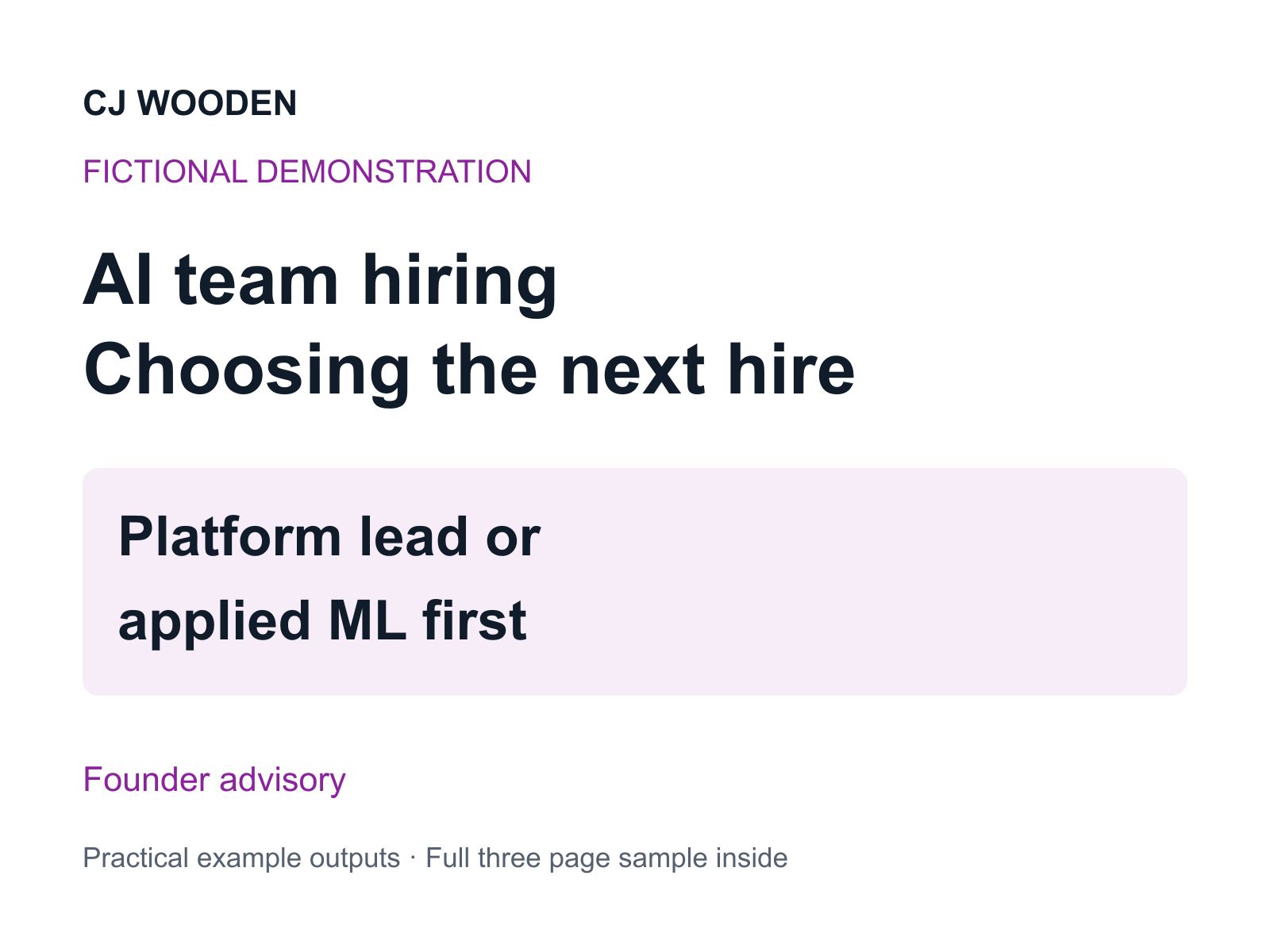
Choosing the next hire for an AI team fictional demonstration cover

FICTIONAL DEMONSTRATION

Choosing the next hire for an AI team

A decision memo comparing a platform lead with a first applied ML hire, including assumptions, evidence and a proposed hiring sequence.

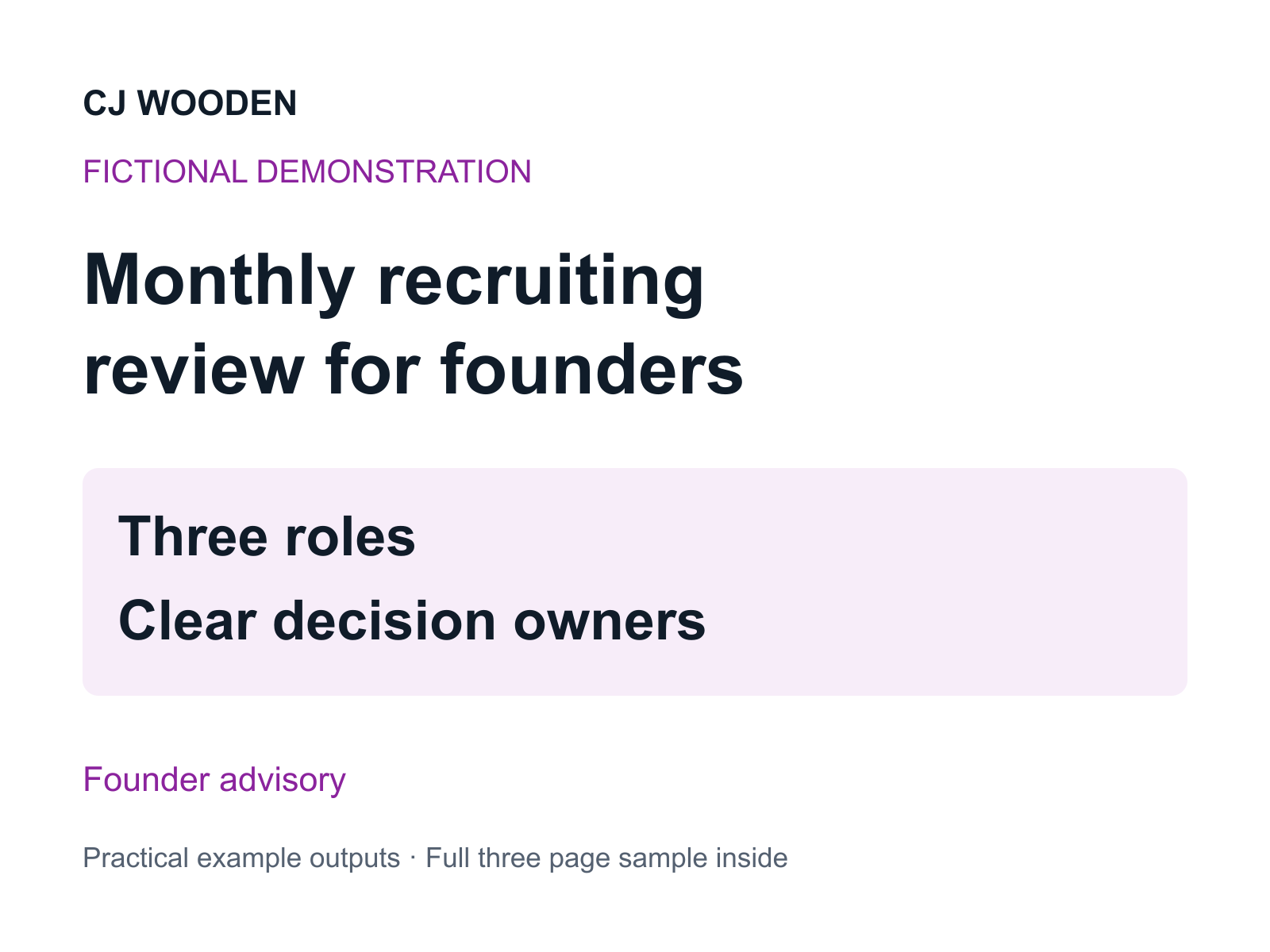
A founder monthly recruiting review fictional demonstration cover

FICTIONAL DEMONSTRATION

A founder monthly recruiting review

A monthly review of three roles, stage aging, interview capacity and the decisions a founder needs to own.

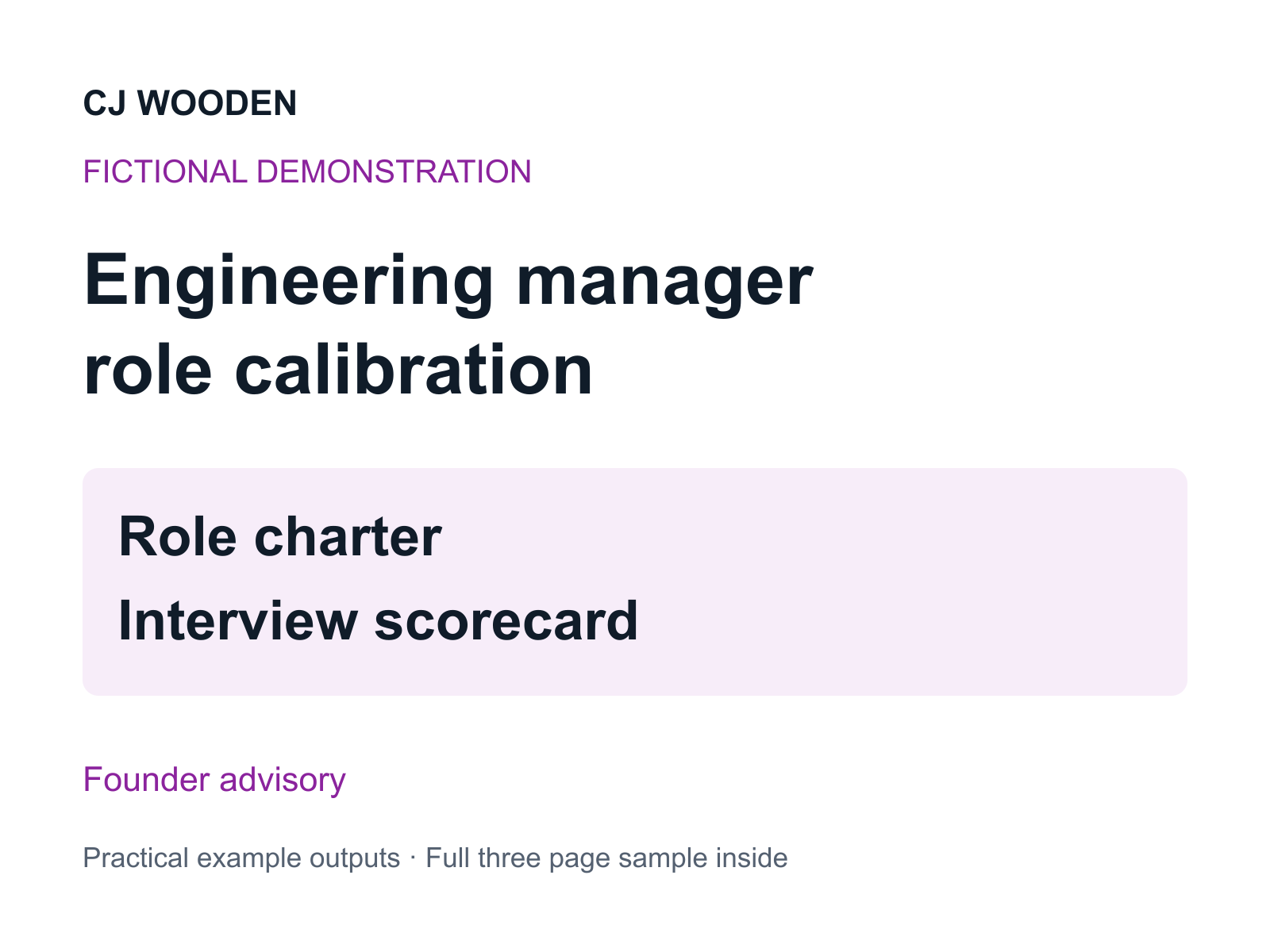
Calibrating an early engineering manager role fictional demonstration cover

FICTIONAL DEMONSTRATION

Calibrating an early engineering manager role

A role charter, interview prompts, rating guide and completed fictional assessment for an early engineering manager.

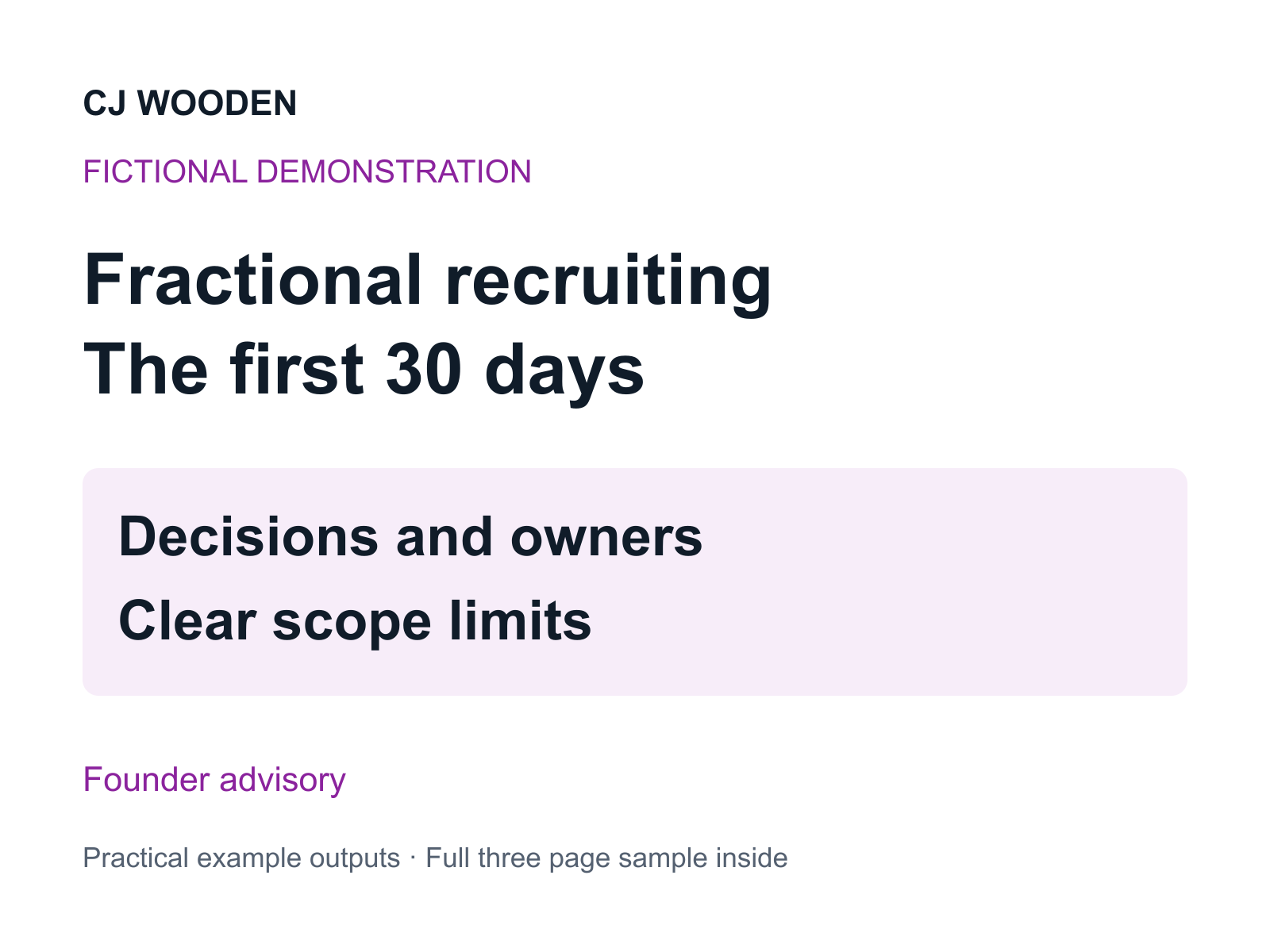
The first 30 days of a fractional recruiting advisory engagement fictional demonstration cover

FICTIONAL DEMONSTRATION

The first 30 days of a fractional recruiting advisory engagement

A first-month advisory plan with decisions, owners, deliverables, a 20-hour example limit and clear scope boundaries.

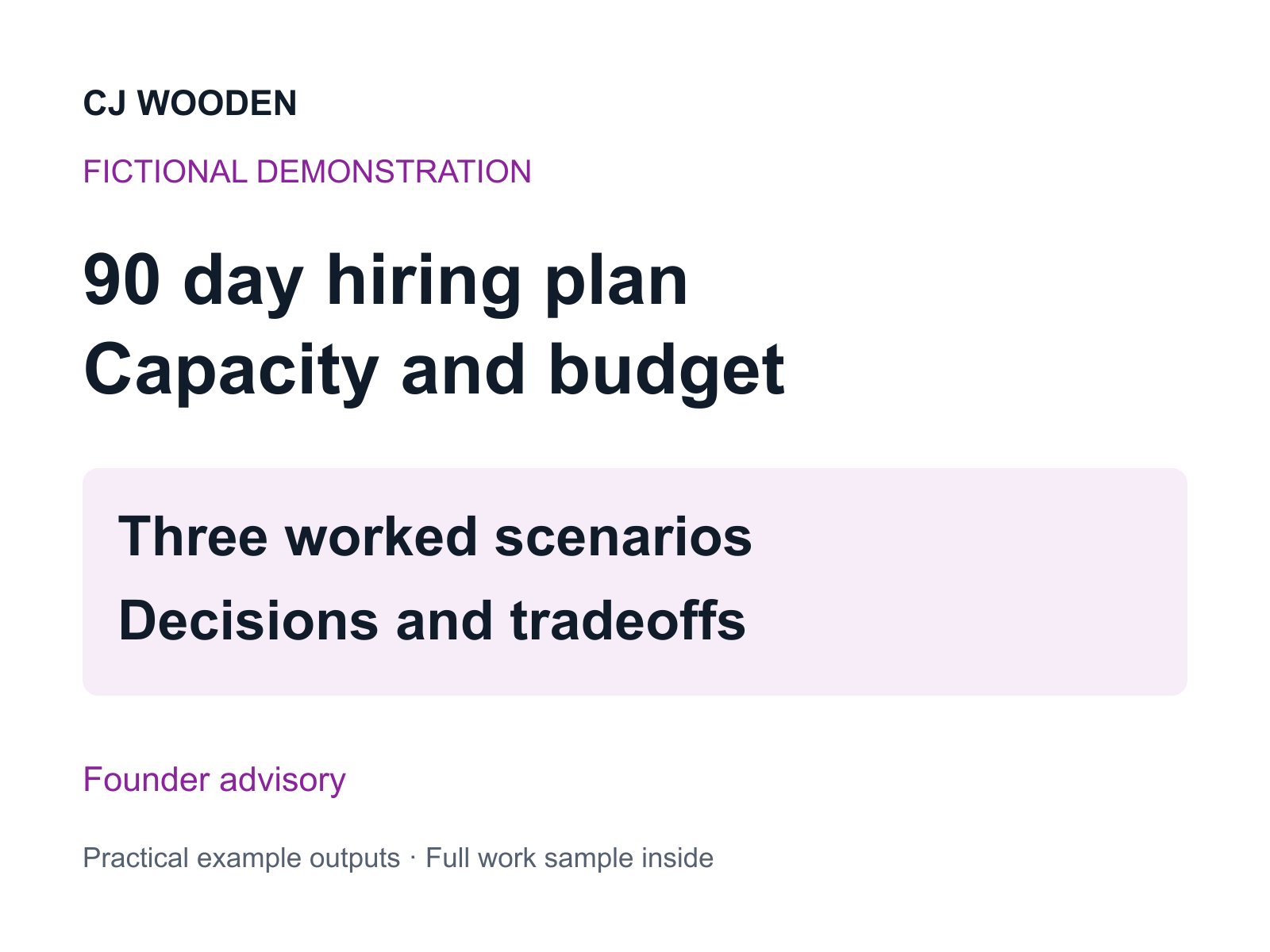
A 90 day hiring capacity and budget plan cover

FICTIONAL DEMONSTRATION

A 90 day hiring capacity and budget plan

Three hiring scenarios with worked cost assumptions, recruiting capacity and founder decisions.

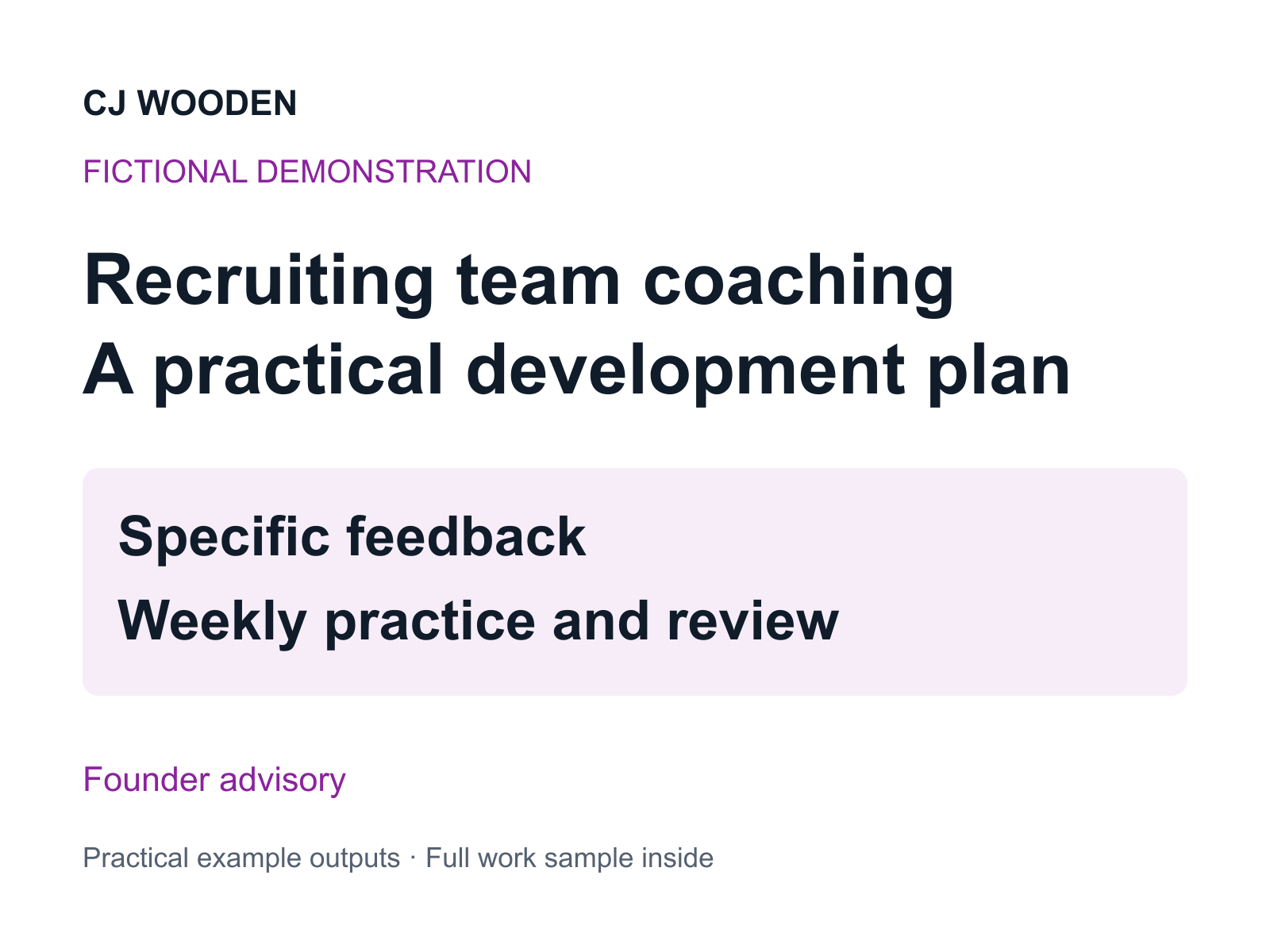
A recruiting team coaching and development plan cover

FICTIONAL DEMONSTRATION

A recruiting team coaching and development plan

A worked coaching review with evidence, a completed feedback example and a four-week development plan.

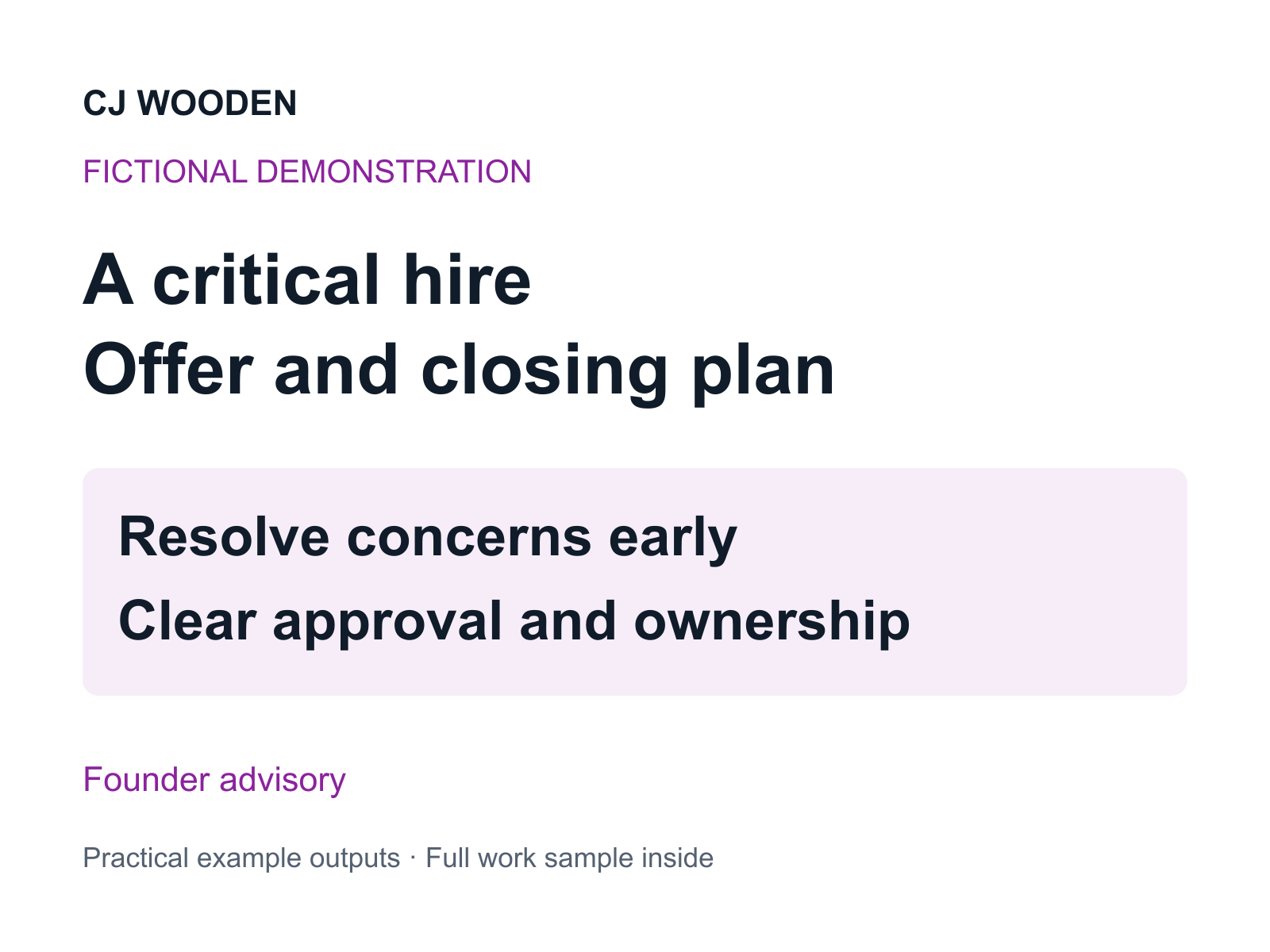
An offer and closing plan for a critical hire cover

FICTIONAL DEMONSTRATION

An offer and closing plan for a critical hire

A fictional offer-readiness review covering evidence gaps, candidate concerns, decision authority and a closing sequence.

Recruiting operations examples

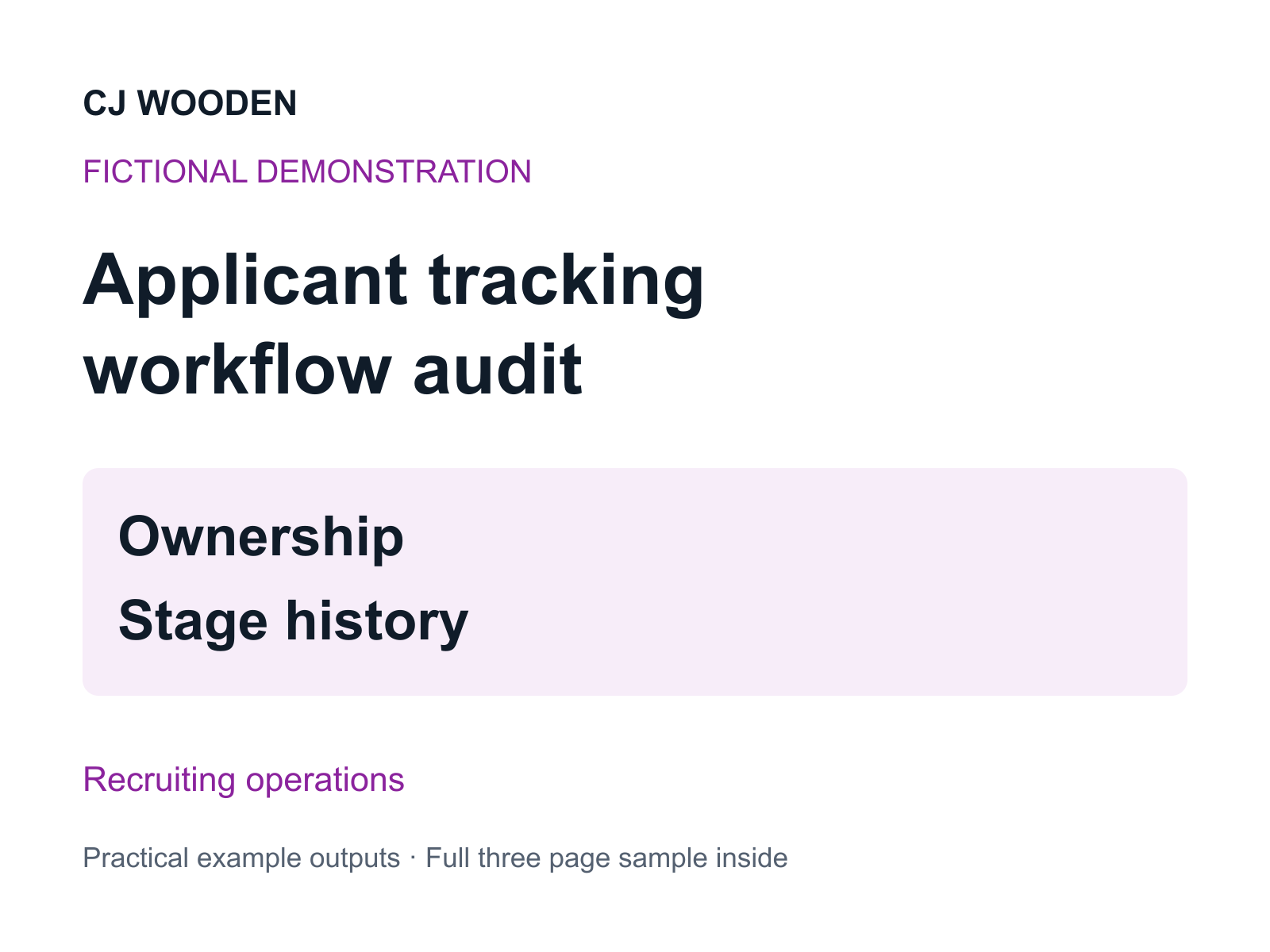
Auditing a distributed recruiting workflow fictional demonstration cover

FICTIONAL DEMONSTRATION

Auditing a distributed recruiting workflow

An audit of a fictional distributed infrastructure team, with application ownership, stage definitions, record rules and validation tests.

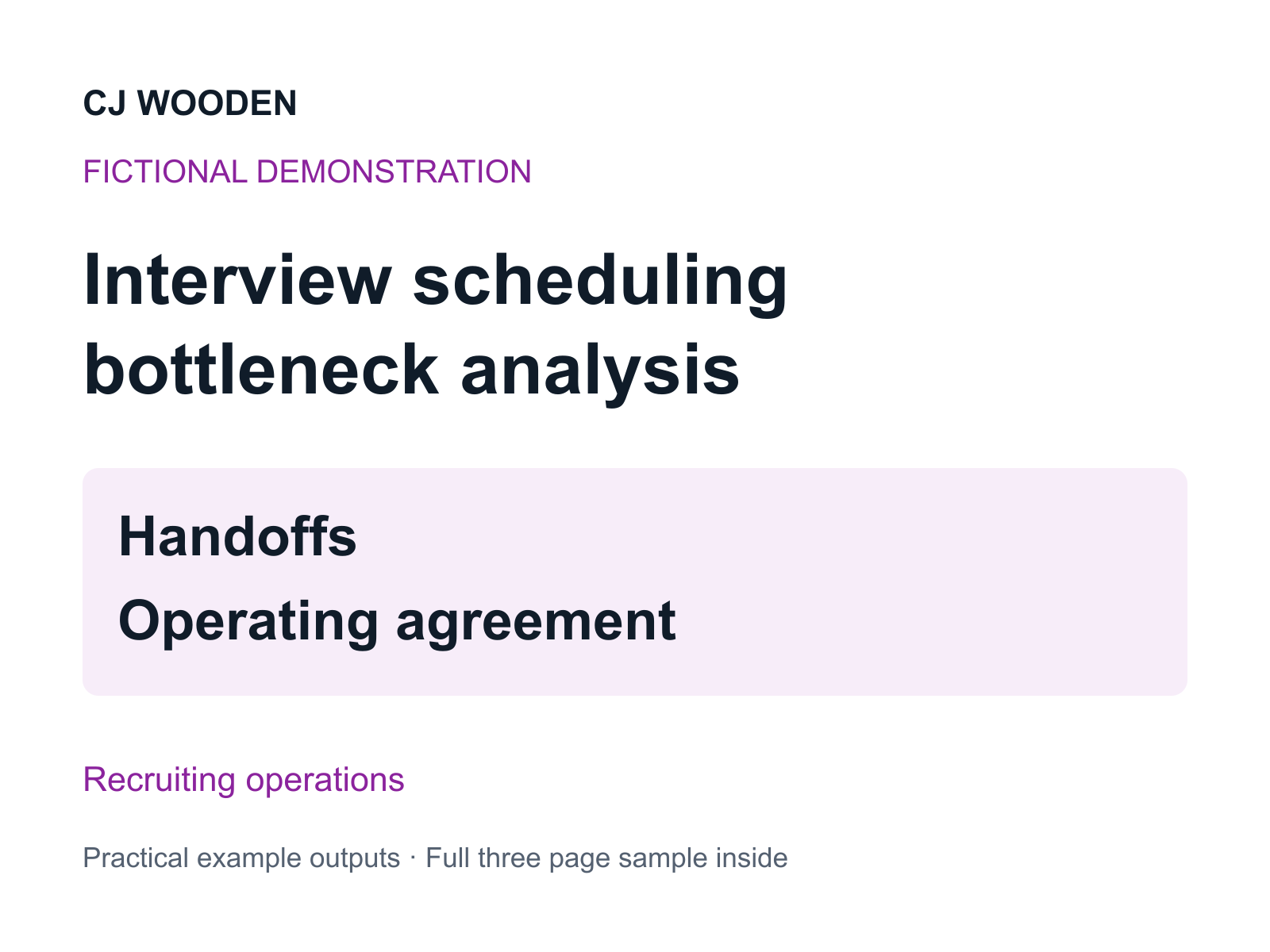
Reducing interview scheduling delays fictional demonstration cover

FICTIONAL DEMONSTRATION

Reducing interview scheduling delays

A worked scheduling delay analysis with an operating agreement, example action record and candidate update.

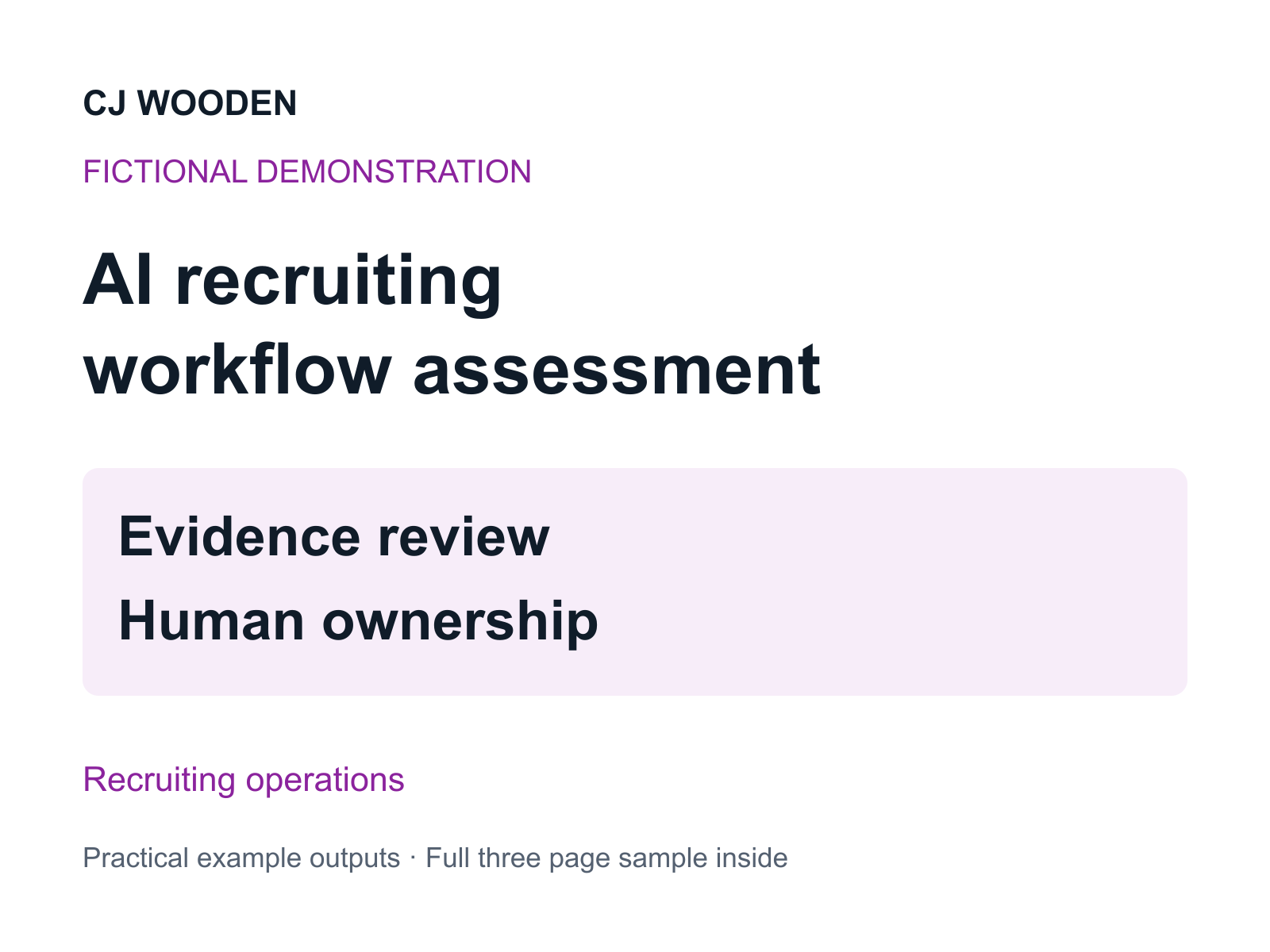
Assessing an AI assisted recruiting workflow fictional demonstration cover

FICTIONAL DEMONSTRATION

Assessing an AI assisted recruiting workflow

A fictional AI drafting workflow assessment covering evidence review, information boundaries, human ownership and acceptance tests.

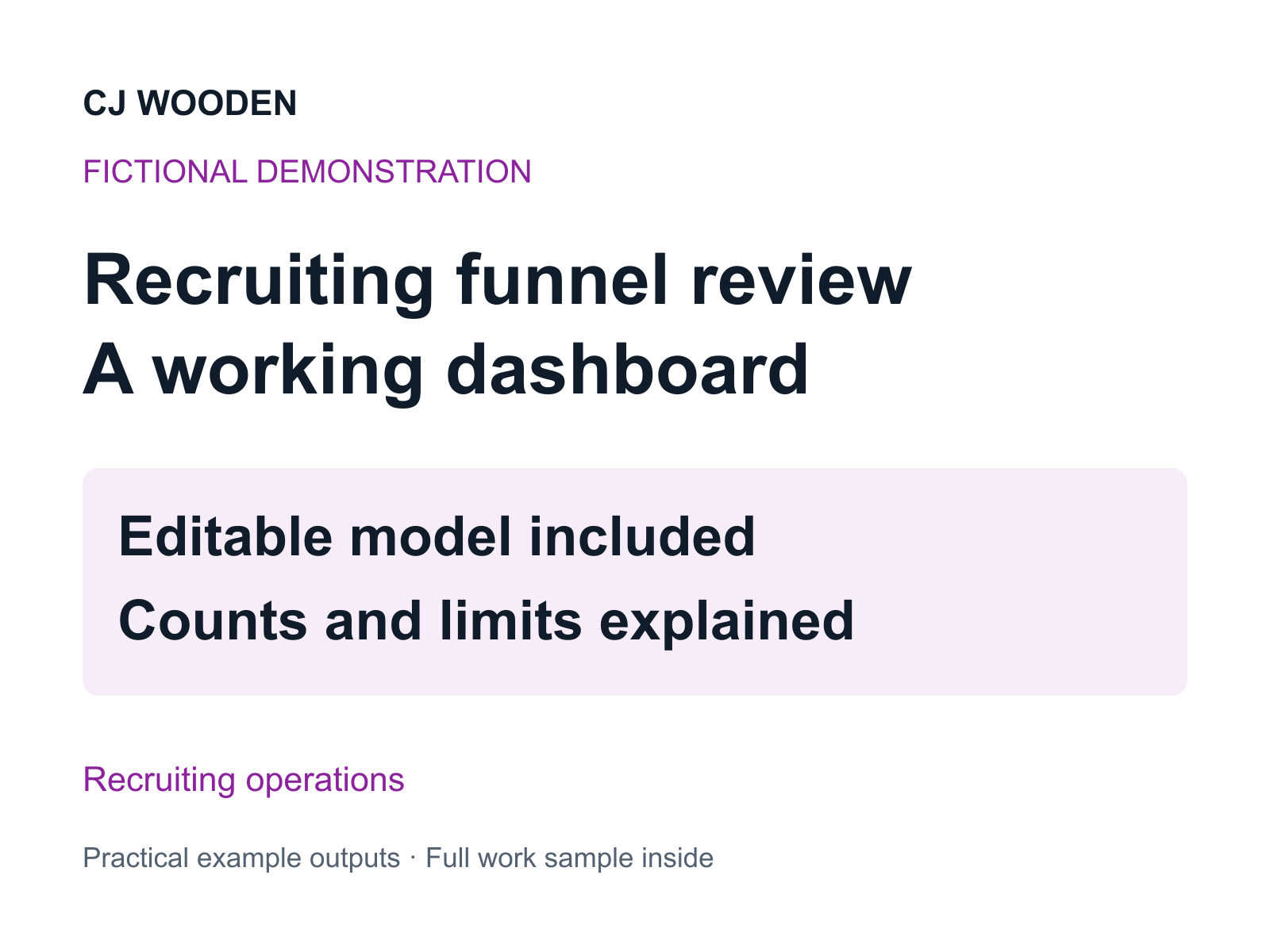
A recruiting funnel dashboard and decision memo cover

FICTIONAL DEMONSTRATION

A recruiting funnel dashboard and decision memo

A working spreadsheet and interpretation memo using synthetic cohorts, resolved offer decisions and active stage ages.

Technical talent mapping examples

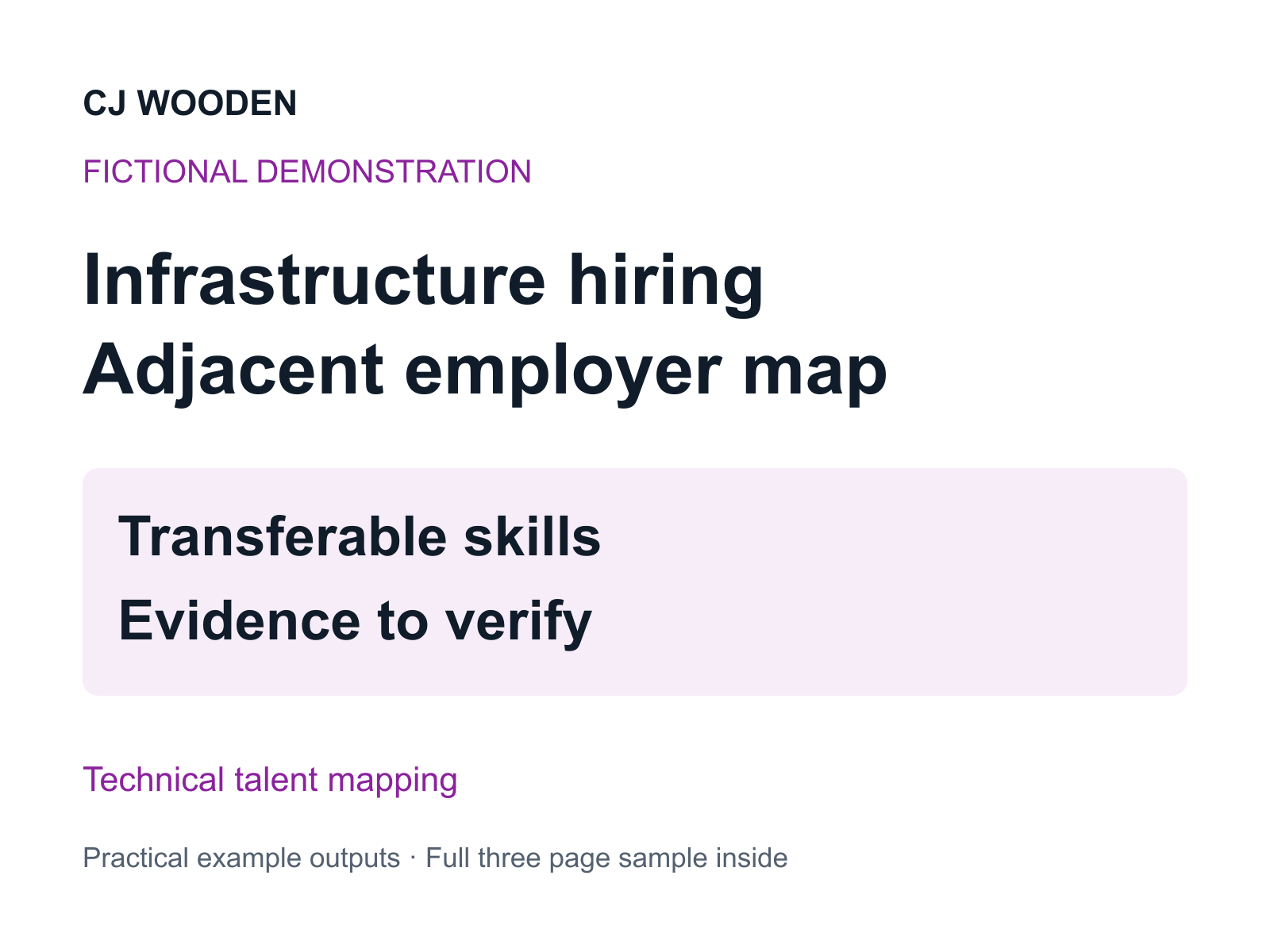
Mapping adjacent employers for an infrastructure hire fictional demonstration cover

FICTIONAL DEMONSTRATION

Mapping adjacent employers for an infrastructure hire

A research map comparing adjacent employer groups, transferable infrastructure skills and evidence still to verify.

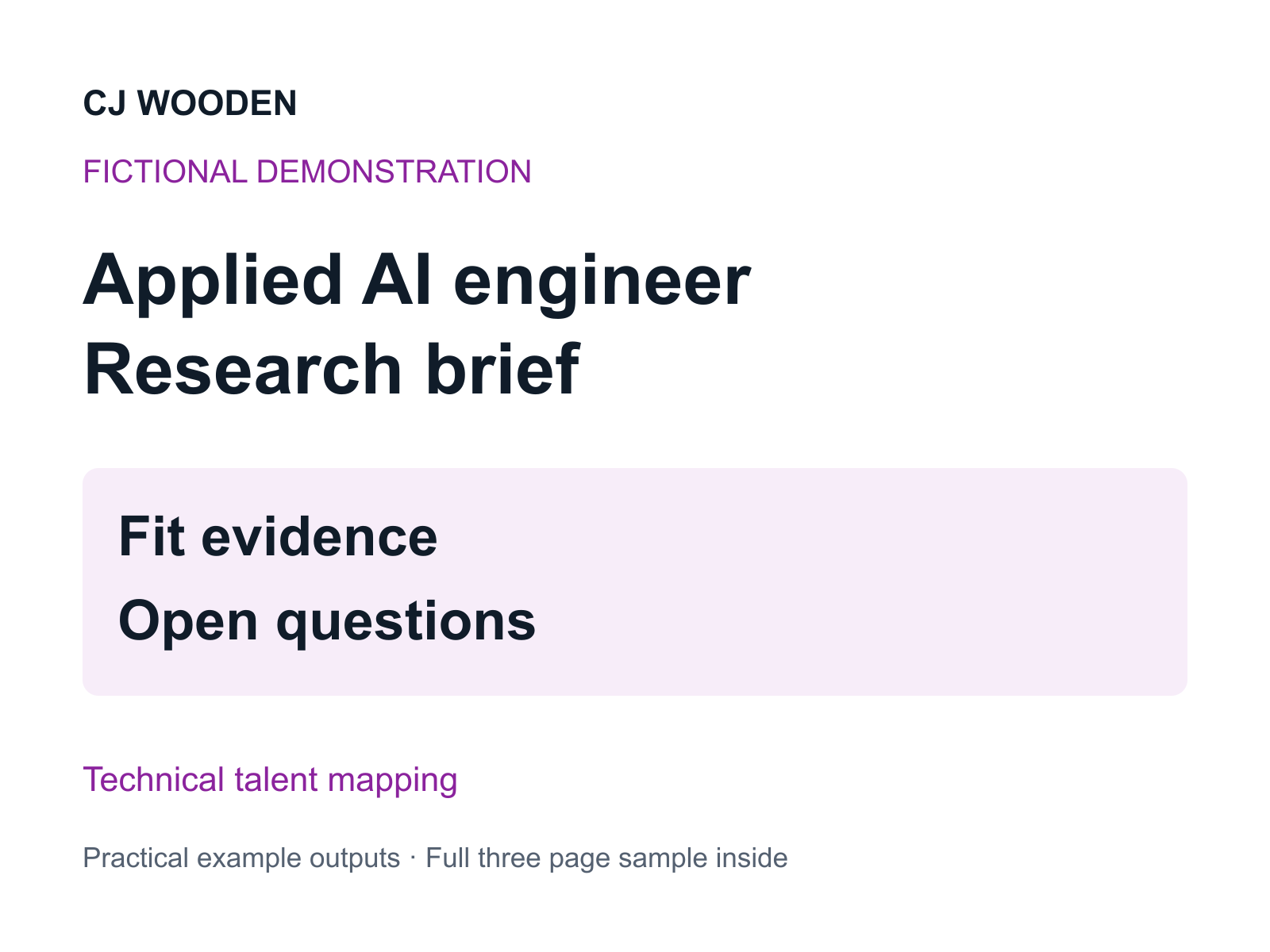
Researching an applied AI engineer for a support product fictional demonstration cover

FICTIONAL DEMONSTRATION

Researching an applied AI engineer for a support product

An applied AI engineer research brief with worked evidence notes, evaluation limits and focused follow-up questions.

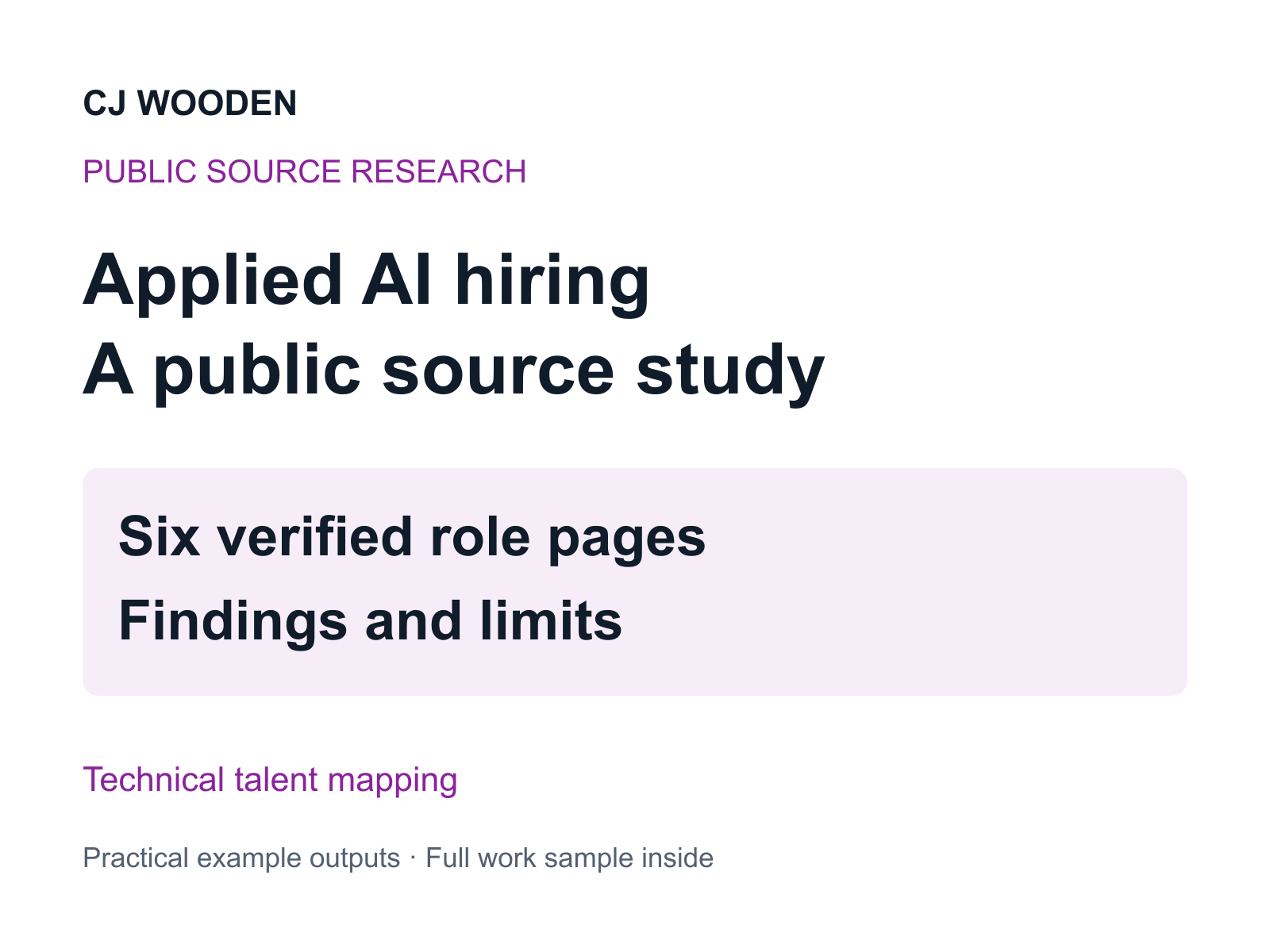
A public source study of an applied AI hiring brief cover

PUBLIC SOURCE RESEARCH DEMONSTRATION

A public source study of an applied AI hiring brief

Six live employer role pages tested against an assumed US product AI brief, with source checks and explicit limits.

03 / TESTIMONIALS

What Clients Say

“Six months of searching. Three weeks with CJ. I'd call that the whole ballgame.”

We'd been trying to fill a senior AI engineer role for six months. Not just anyone, someone who actually understood RAG pipelines, token optimization, and what it looks like when things break at scale in production. I'd worked with agencies before and kept getting candidates with great resumes who fell apart when I asked them to walk me through a chunking strategy or talk about cost-efficient inference. Impressive on paper, useless in practice.

CJ was different from the first conversation. He understood what we were actually trying to build, not just the job description. The way he communicated with our leadership team gave me confidence early. It felt less like working with an outside recruiter and more like someone who'd already been embedded with us.

Three weeks in, he brought me someone who wasn't even on the market. An engineer who'd built and scaled AI systems to millions of requests and could have a real conversation about latency versus quality trade-offs, not recite talking points. The close was smooth and low-pressure, which honestly matters more than people think when you're dealing with passive candidates.
Marcus L.VP Engineering, AI Technology Company

“Worth every dollar. Paid for itself in the first week.”

Honestly, we were buried. Résumés flooding in from people with AI PhDs, "LLMOps specialist" in their title, the whole thing, and most of them couldn't actually ship. Ask them about token cost trade-offs or walk you through a production RAG pipeline and you'd get a blank stare. Prompt engineers cosplaying as AI engineers.

CJ cut through it fast. Within a week he showed us exactly where our job descriptions were pulling in the wrong people and accidentally screening out the ones we actually wanted. The video he put together didn't feel like a consultant deliverable. It felt like talking to someone who'd already spent time understanding how our team thinks and what we're actually trying to build.

The fix wasn't just a list of problems. It was sequenced, prioritized, and actionable. We started implementing it and within two weeks the conversations we were having with candidates were completely different. These were engineers who talk in latency budgets, not buzzwords.

Anya S.CTO, AI Technology Company

04 / STARTING POINTS

Clear pricing.
Scope built around the work.

Engagements typically start at $1,500 for a focused talent mapping sprint, $3,500 for a hiring systems audit, and $5,000+/month for ongoing advisory or embedded recruiting support.

Project-based recruiting starts at $8,500. We’ll agree on scope, priorities, and the right level of support before work begins. All prices are in USD.

View ways to work together
CJ Wooden, AI & Technical Talent Advisor
CJ Wooden Fractional Recruiting Advisor

05 / YOUR ADVISORY PARTNER

I’ve built teams where
the stakes were real.

My career began in the Army, leading people as a staff sergeant. From there, hands-on Linux and infrastructure work gave me a practical understanding of the systems engineers build—and the judgment their work requires.

I brought that perspective to technical recruiting at Google X, Meta/Facebook, and Criteo. Today, I work with founders and growing teams as a Fractional Recruiting Advisor or Head of Talent. I also offer recruiting operations consulting and technical talent mapping when a defined project fits the need. My work combines 10+ years of technical recruiting experience with practical hiring strategy and AI-assisted workflows.

AI can accelerate the research. Experience, context, and human judgment still guide the hire.

AI & TECHNICAL TALENT FOCUS

AI & machine learningEngineeringInfrastructure & SRERoboticsSecurityProduct
Professional development

SHRM Talent Acquisition · Generative AI for Recruiters · SHRM AI in HR · Behavioral Event Interviewing · Hogan Assessment

06 / INSIGHTS

A practical view of
AI, talent, and hiring.

How I think about evaluating talent, choosing recruiting technology, and building better operations.

AI TALENT EVALUATION

A polished answer isn’t proof of good judgment.

For an AI role, I want to understand the decisions behind the demo: what the candidate tested, what failed, and what they changed.

Read my perspective

Start with the work the person will own. Ask them to explain a trade-off, walk through a failure, and describe how they would know their solution was working. A candidate who can name the limitations gives me more to evaluate than one who only describes the happy path.

My starting point: agree on the evidence before the interview. Then use a scorecard that separates technical execution, evaluation, and judgment. Fluency with AI tools is one input into that decision.

RECRUITING TECHNOLOGY

Give the AI tool a job before you buy it.

I start with the bottleneck: research, outreach, handoffs, or reporting. Then I ask whether a tool improves that part of the workflow.

Read my perspective

A good demo is a starting point. I want to try the product against a real role, inspect the output, and count the corrections it needs. Candidate matches should be explainable; outreach should be relevant; handoffs should reach the system where the team actually works.

My test is practical: does this save useful time after review and cleanup? Keep a person responsible for candidate evaluation and external communication, and define what needs approval before automating the task.

AI PM & ENGINEERING TALENT

“We need an AI person” is the beginning of the brief.

Before sourcing, I ask what the team needs to ship, who owns the technical decisions, and how success will be evaluated.

Read my perspective

An AI product manager and an AI engineer may work on the same problem, but I would look for different evidence. For product, I want clarity on the user problem, priorities, evaluation criteria, and adoption. For engineering, I want evidence of implementation, testing, reliability, and technical trade-offs.

Those boundaries vary by team. Write down the first outcomes the hire must deliver, the decisions they will own, and the support they will have. That gives sourcing and interviewing a shared target.

LET’S GET TO WORK

Where does your hiring
need to work better?

Tell me how your company is growing and where hiring needs more attention. We can work out whether you need ongoing recruiting leadership, help with the process, or a clearer view of the talent market.

Schedule a 30-minute introductory call